
Is your business struggling with these issues?
✅ Protracted new product development cycles, causing you to miss market windows?
✅ Prohibitive mold opening costs, making sample testing unbearably expensive?
✅ Struggling to find efficient and economical solutions for small-batch trial production?
If you’re nodding along, then you need to learn about this “golden combination” adopted by numerous leading manufacturing companies – “3D Printing + Vacuum Casting”.
Part 1: Pain Points in Traditional Sample Manufacturing – How Many Affect You?
Creating samples for appearance and functional testing before mass production is essential. But traditional methods often mean:
Exorbitant Mold Costs: Creating a steel mold for a single sample can cost tens of thousands, making trial-and-error prohibitively expensive.
Long Lead Times: The process from design to receiving samples is cumbersome, often taking weeks, slowing down the entire project.
Design Limitations: Complex structures, fine details, undercuts, etc., are difficult or extremely costly to achieve with traditional molds.
Conclusion: Using production molds for sampling is overkill – a massive waste of money, time, and effort!
Part 2: The Solution: The “3D Printing + Vacuum Casting” Golden Combo
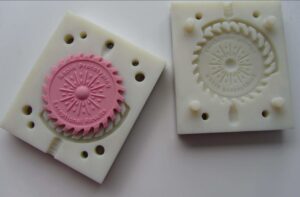
The core concept is simple: use a disposable 3D printed prototype to create a reusable silicone mold, enabling the fast and inexpensive replication of high-performance plastic functional parts.
Its workflow is highly efficient:
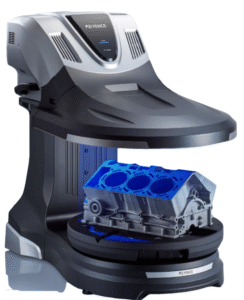
Using 3D printed parts as masters, combined with vacuum casting technology, enables efficient production of small-batch parts. Vacuum casting is a type of rapid tooling technology. It involves creating a silicone mold from a master pattern under vacuum conditions, and then pouring material (such as ABS, PP, PC, high-temperature resins, etc.) into the silicone mold, also under vacuum, to rapidly produce plastic parts identical to the master.
Part 3: Why is it the Ultimate Answer to the “Cost Dilemma”?
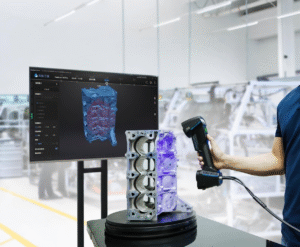
By choosing vacuum casting technology, you gain three core benefits:
Benefit 1: Drastic Cost Reduction – End Prohibitively Expensive Trials
Eliminate High Mold Costs: A silicone mold costs a fraction of a steel mold, allowing you to obtain test samples for less than 1/10th of the cost.
High Material Utilization: Vacuum casting minimizes waste, making it ideal for expensive engineering plastics.
Benefit 2: Lightning-Fast Response – Beat Development Timelines
Lead Times Measured in Days: From receiving your 3D model to producing the first samples takes just 3-7 days, slashing lead times by over 70% compared to traditional mold opening.
Rapid Iteration: Need a design change? Simply re-print a new master, enabling fast design iterations and getting your product to market quicker.
Benefit 3: Unmatched Capability – Unleash Design Freedom
Versatile Master Materials: A single master can produce multiple copies, and the master can be made from various materials like metal, plastic, or plaster.
Excellent Demolding: The flexibility of silicone molds allows for easy demolding of highly complex parts, even those with undercuts.
Easy Mold Handling: Cured silicone molds are transparent/semi-transparent with good tensile strength, facilitating cutting and parting line definition.
High Repeatability: The fluidity of silicone before curing, combined with vacuum degassing, accurately captures fine details, minimizes bubbles and sinking marks, yielding superior sample quality.
Multi-Component Production in One Step: Molds for all components of an assembly can be placed in the vacuum casting machine and cast simultaneously with the same material.
Part 4: The Role and Trends of Vacuum Casting in Industrial Manufacturing
As industrial product development accelerates, the demand for resin prototypes continues to grow. Typically, before mass-producing plastic products, samples are needed to evaluate aesthetics or conduct functional tests to finalize the design.
Vacuum casting technology typically uses 3D printing to create the master pattern and employs silicone molds for production. Silicone is ideal for creating flexible molds due to its excellent replication capability, strength, and very low shrinkage. Silicone molds withstand repeated use, maintain precise tolerances between prototype and production parts, and can directly produce complex shapes, eliminating needs for milling or polishing. Demolding is easy, significantly shortening product development cycles. Furthermore, due to their flexibility and elasticity, parts with complex structures, fine details, zero draft angles, or deep cavities can be easily removed after casting – a unique advantage over other mold types. Vacuum casting drastically reduces development costs and risks, shortens lead times, and effectively addresses the cycle time and cost challenges in new product development.

Part 5: Who is Using It to Reduce Costs and Boost Efficiency?
This technology is widely used across industries including:
Automotive Manufacturing: Functional prototypes for headlights, dashboards, interior components.
Consumer Electronics: Trial production and small batches of phone housings, audio equipment, computer parts.
Home Appliance Industry: Validation of new structural components for refrigerators, washing machines, microwaves, etc.
Medical Devices: Customized, small-batch products like prosthetics and instrument housings.
Part 6: Take Action Now! Unlock a New Engine of Efficiency for Your Business!
We are not just technology providers; we are your strategic partners in R&D. As professional vacuum casting manufacturers, we offer:
Free Project Evaluation: Is your product suitable? Submit your drawings for our engineer’s assessment.
Rapid Prototyping Service: Quick turnaround ensures you get high-quality samples in the shortest time.
Reliable Small-Batch Supply: A single silicone mold can produce 10-20 copies, perfectly meeting needs for pilot runs, trade show samples, or product launch campaigns.
Leave a Reply