
When embarking on a specific new product development project, engineers and designers consistently face a core dilemma: Should I use 3D printing, CNC machining, or vacuum casting? The truth is, no single rapid prototyping process excels in all aspects. The most efficient strategy is to intelligently combine these technologies according to different stages of your product development cycle. This article provides a clear decision-making framework, illustrated with a typical hardware development workflow, to help you optimize for speed, cost, and fidelity.
Decision Matrix: A Core Dimensional Analysis
Before deciding, evaluate your project requirements against these four critical dimensions. This comparison is crucial for effective low volume manufacturing planning.
| Evaluation Dimension | 3D Printing (SLA/SLS) | CNC Machining | Vacuum Casting (Urethane Casting) |
| Ideal Stage | Concept Proof-of-Concept, Functional Prototypes | High-Precision Functional Prototypes, Metal Components | Low-Volume Production, Pre-Production Appearance Parts |
| Speed | Very Fast (Hours to Days) | Medium (Depends on Complexity) | Mold Making is Slow (5-10 Days), But Replication is Fast |
| Unit Cost | Low to Medium | High | High Mold Cost, but Extremely Low Unit Cost (After Setup) |
| Material & Performance | Wide Range, Properties Close to Engineering Plastics | Real Engineering Materials (Metals/Plastics) | Performance Closest to Injection-Molded Parts, Wide Aesthetic Selection |
Case Study: Smart Home Device Development Workflow
Consider the development of a smart speaker with a metal base and a plastic enclosure.

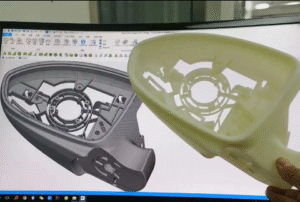
Phase 1: Internal Structure & Circuit Verification (Week 1)
Challenge: Validating PCB mounting post locations, heat dissipation structures, and internal component stacking.
Process Choice: Use SLS 3D printing to create the internal chassis.
Reasoning: SLS can print complex internal cavities and snap-fits monolithically without supports. It offers sufficient strength for multiple assembly tests and is significantly more cost-effective than CNC machining for this geometric complexity, accelerating early-stage rapid prototyping.
Phase 2: High-Fidelity Appearance & Assembly Testing (Weeks 2-3)
Challenge: Achieving precise assembly gaps, surface texture, and testing metal-plastic integration.
Hybrid Process Combination:
Plastic Enclosure: Use high-gloss SLA 3D printing followed by professional painting to achieve a perfect, ABS-like glossy finish.
Metal Base: Employ CNC aluminum machining with anodizing for authentic weight, feel, and thermal performance.
Value: This hybrid approach delivers a near-production prototype suitable for executive reviews and reliability testing within 1-2 weeks, bridging the gap between prototype and production.
Phase 3: Pre-Production & Market Launch Testing (Week 4 Onward)
Challenge: Needing 50-200 high-quality units for beta user testing, trade shows, or early sales channels.
Process Choice: Vacuum Casting.
Reasoning: Using a perfected SLA master model from the previous phase, a silicone mold is created. This mold allows for batch replication using polyurethane resins. Each copy boasts consistent, injection-molding-like appearance and performance, while unit cost and lead time are far lower than CNC machining or individual printing. This makes it the optimal low volume manufacturing china solution for market validation.
Conclusion: The Wisdom of Dynamic Selection
A successful low volume manufacturing strategy is fluid. In the early stages, 3D printing provides unmatched speed and flexibility. When ultimate performance is required, CNC machining offers irreplaceable material authenticity. When moving toward the market, Vacuum Casting effectively bridges the gap between prototyping and full-scale production, a key consideration for fields like vacuum casting for medical devices or consumer electronics.
Final Recommendation: At the outset of your project, share your complete development roadmap with a supplier possessing comprehensive manufacturing capabilities. They can tailor a time and cost-efficient hybrid process plan, ensuring seamless transitions between stages and helping you launch your product to market faster and with greater confidence.
Leave a Reply