
Do you often find yourself troubled by this dilemma: “I have a fantastic product design idea and want to create a physical prototype for verification, presentation, or small-scale market testing. The two common methods available are vacuum casting and injection molding—which one should I ultimately choose?”
Worry no more. Today, I will break down the differences between these two methods thoroughly, so you can make a decision with confidence.
What is Vacuum Casting?
In simple terms, vacuum casting is a “silicone mold replication process.”

Creating a Master Pattern: First, we need a high-quality master pattern (typically made from 3D-printed photosensitive resin and meticulously polished).
Creating a Silicone Mold: The master pattern is encased in a silicone block, placed in a vacuum chamber to remove air bubbles, and then heat-cured to form a flexible silicone mold.
Casting Replicas: The silicone mold is carefully cut open to remove the master pattern. The mold is then closed, and a prepared liquid resin (such as polyurethane/PU) is injected into the mold under a vacuum environment.
Curing and Demolding: After the resin cures in a constant-temperature oven, the silicone mold is opened to reveal a replica that is nearly identical to the master pattern in both appearance and texture.
In short: A single silicone mold can produce 20-30 product prototypes with excellent appearance and texture.
What is Injection Molding?
Injection molding embodies “the steadfastness of steel for mass production.”
Creating the Steel Mold: First, a precise and robust cavity mold must be engraved from high-hardness steel (such as 718, S136). This process involves high costs and long lead times.
High-Temperature Injection: Pelletized plastic materials (e.g., ABS, PC, PP) are heated until they melt into a fluid state.
High-Pressure Filling: The molten plastic is injected into the steel mold cavity under extremely high pressure.
Cooling and Ejection: After the plastic cools and solidifies inside the mold, the mold opens, and ejector pins push out the finished part.
In a nutshell: A single steel mold can produce tens of thousands to millions of identical product components.
Key Differences: A Table to Guide Your Choice
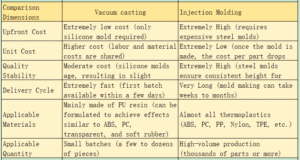
Expert Summary: Your Selection Guide
If your needs include:
-
- Product development validation, design reviews, market research, or exhibition samples
- Small-batch production (dozens of units or fewer)
- Limited budget with a strong emphasis on maximum speed
Choose [Vacuum Casting] without hesitation. It delivers high-quality samples with appearance and texture closely resembling the final product, at the lowest cost and fastest turnaround.
If your requirements include:
-
- Having a finalized design and preparing for full-scale mass production
- Needing tens of thousands of components
- Having stringent requirements for product strength, durability, and quality consistency
Then investing in injection molding from the outset is the most strategic and cost-effective long-term choice. Although the initial tooling costs are high, they are significantly offset by the extremely low per-unit cost at large production volumes.

After reading this article, I believe you now have a clear understanding of how to make your choice. As a prototyping expert, I’m truly eager to learn about your project details and provide you with the most professional manufacturing advice.
Don’t let your ideas remain confined to sketches—reach out to me now! Give me just one week, and I’ll bring you face-to-face with your creation.
Leave a Reply