
In the World of Drones, Speed is the Only Rule. And When R&D Speed Catches Up with Flight Speed, a Revolution in Innovation Begins.
Every leap in drone performance is rooted in the evolution of its skeleton and wings – the fuselage and wings. Composite materials like carbon fiber and fiberglass have become the go-to choices for achieving lightweight, high strength, and high rigidity.
However, a core contradiction has persistently troubled developers: the mold development for these advanced components has traditionally been a time-consuming and costly process.
The “Speed Trap” in Drone R&D
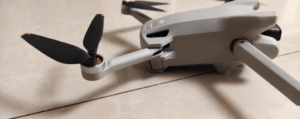
Traditional metal mold manufacturing often takes weeks, with costs soaring to tens or even hundreds of thousands of RMB. For drone companies that rely on rapid iteration and market agility, this is undoubtedly a heavy burden.
High Cost of Iteration: A single design change means scrapping and completely remaking the entire mold.
Misaligned Timelines: A month-long wait for a mold is enough for a highly promising market opportunity to vanish.
Small-Batch Production Dilemma: The cost of mold opening makes it economically unviable to produce small quantities of specialized components for specific applications (like agricultural spraying, power line inspection).
The drone industry urgently needs an agile manufacturing solution to break this deadlock.
The Game Changer: Vacuum Forming Technology
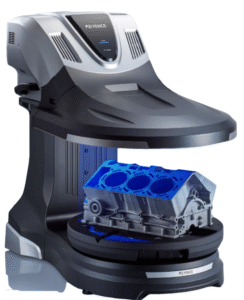
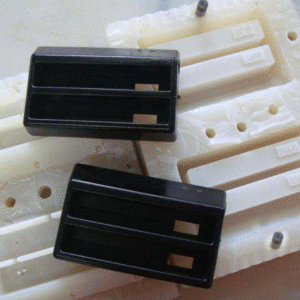
Vacuum forming technology is born from the need to solve this very problem. It is essentially a rapid, high-precision soft tooling process that creates composite parts using a flexible mold, enabling the quick replication of high-performance composite components.
Its core process can be simplified into three steps:
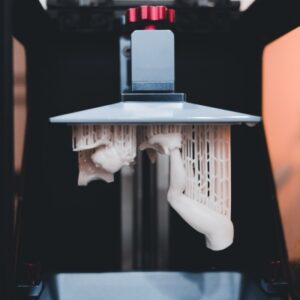
Master Pattern Creation: A “positive prototype,” identical to the final product, is created using high-precision 3D printing (e.g., SLA) or CNC machining.
Silicone Mold Formation: A silicone mold is produced via vacuum infusion, perfectly conforming to this prototype. The vacuum environment ensures the mold is bubble-free, highly dense, and replicates every detail flawlessly.
Composite Part Formation: This high-precision silicone mold acts directly as the tool for laying up carbon/fiberglass fabric. It is then used in a vacuum infusion or autoclave system to finally cure and form the high-performance composite part.
Why is Vacuum Forming the “Perfect Partner” for Drone Development?

- Unmatched Speed: From “Months” to “Days”Traditional steel molds: 2-3 weeks | Vacuum-coated silicone molds: 1-2 days. The rapid curing properties of silicone molds reduce mold-making time by over 80%. Engineers can complete the design this week and receive a testable physical component next week, allowing R&D iteration cycles to be calculated in days.
- Unbeatable Cost: As Low as 1/10th of Mold Cost
Compared to traditional molds costing a fortune, vacuum forming drastically reduces the cost per iteration, thanks to low-cost silicone materials and efficient processing. This allows teams to freely experiment with multiple design variations and thoroughly validate the optimal solution. - Ultimate Precision: The “Cloning” of Complex Aerodynamic Shapes
Components like drone propellers and complex airfoils feature intricate aerodynamic curves and microstructures. The vacuum forming process, conducted under vacuum, replicates every feature of the master pattern with 100% fidelity, achieving accuracies up to ±0.1mm. This ensures every copied part possesses the exact aerodynamic performance of the original design.
Practical Applications: Seamless Transition from Concept to Flight
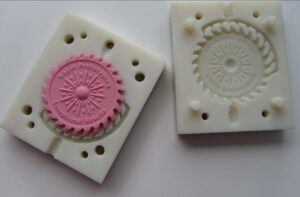
Wing/Empennage Prototyping: Before committing to huge mold costs, use molds created via vacuum forming to produce small batches (5-10 units) of wings for wind tunnel testing, static stress tests, and actual flight verification.
Propeller Design & Optimization: Quickly produce multiple propellers with different blade pitches and airfoils for efficiency and noise testing, identifying the best performer.
Custom Fuselage Shells: Rapidly manufacture lightweight, aerodynamic fuselage shells for specialized drones (e.g., for surveying, logistics), enabling small-batch custom production.
Rapid Repair & Tooling: Even for finalized models, this technology can be used to quickly produce replacement parts or repair tooling for vulnerable components, significantly reducing downtime.
Conclusion: Winning the Market Starts with Accelerating R&D
In the technology-intensive, fiercely competitive field of drones, R&D speed is itself a moat. Vacuum forming technology, by injecting its core advantages of “speed, low cost, and high precision” into the development process of drone composite components, fundamentally changes the pace of the game.
It empowers companies to dare to imagine, courageously iterate, and rapidly validate. It is not just a tool for prototyping but an agile manufacturing strategy that spans the entire product lifecycle – from design and testing to customization and even repair.
When drone design iteration becomes as agile and swift as its flight, the sky for innovation will know no bounds.
Leave a Reply